
The .30-06: A Classic That Never Needed Replacing
- SkillBase Precision Labs

- Jan 9
- 5 min read
Updated: Jan 16
The .30-06: A Cartridge That Defined the All-Rounder
The .30-06 Springfield, introduced in 1906, is one of the rare cartridges whose reputation has never depended on defence. It didn’t rise to prominence through marketing or nostalgia, but through necessity. Developed for military service at a time when reliability, reach, and terminal performance mattered more than optimisation on paper, it was designed to do one thing well: work everywhere.
It replaced the .30-03, bringing a lighter bullet at higher velocity and improved ballistic efficiency. The result was a cartridge capable of accurate fire at distance, reliable feeding under adverse conditions, and consistent performance across climates that ranged from freezing European winters to tropical heat. Those same traits would later make it indispensable beyond the battlefield.
When surplus rifles and ammunition entered civilian hands after the world wars, the .30-06 didn’t fade into obscurity. Instead, it found a second life as a hunting and sporting cartridge, proving that its design principles translated seamlessly into the civilian world.
Why the design still works
Mechanically, the .30-06 is deceptively simple. Its long case provides generous powder capacity, allowing it to operate comfortably across a wide pressure window. This is the foundation of its versatility.
It can drive lighter bullets fast enough for flatter trajectories, or push heavier bullets with deep, predictable penetration. Bullet weights from around 110 grains up to 220 grains are common, each serving a different purpose without forcing the cartridge beyond its comfort zone. Unlike more tightly optimised modern designs, the .30-06 does not live on the edge of pressure limits to perform.
That breathing room is what makes it forgiving of real-world variables. Changes in temperature, altitude, and load development have less dramatic consequences than they do in smaller, more specialised cartridges. In practice, this means reliability where conditions are not ideal — which, in hunting and competition alike, is most of the time.
This is also why the cartridge has been so well suited to South African conditions. From dense bushveld to open plains, it adapts without complaint.
The South African all-rounder
For decades, the .30-06 became the default choice for South African hunters not because it was perfect, but because it was dependable. One rifle could reasonably be expected to handle everything from plains game to larger species without constant reconfiguration or second-guessing.
That practicality mattered. Ammunition was widely available. Components were easy to source. Rifles were robust and familiar to gunsmiths. The cartridge earned trust through repetition, not hype.
That reputation carried forward into sport shooting as well. While not designed as a competition cartridge, the .30-06 proved that accuracy was not limited to lighter calibres. When properly set up and fed with a consistent load, it demonstrated that recoil management and shooter discipline could bridge the gap many assume exists between “hunting rifles” and “precision rifles.”
The rifle that was always “mine”
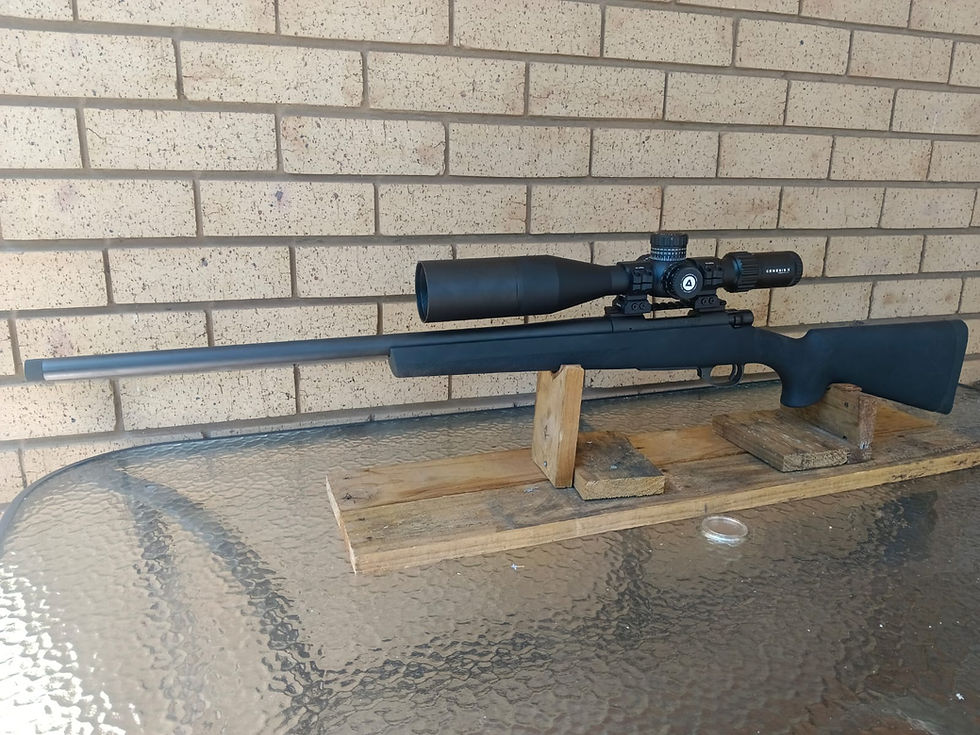
My father bought this .30-06 when I was twelve years old. From the moment it entered our lives, I claimed it without hesitation. “Dis my geweer.” (This is my gun)
It became a running joke, except it wasn’t really a joke. From the beginning, that rifle was the one I trained with, competed with, and hunted with. In 2012, the same year the rifle arrived, I joined a shooting club and began shooting competitively. That was more than a decade ago now, and throughout that entire period, the .30-06 remained constant.
When I turned twenty-one and it officially became my licensed rifle, it felt less like a milestone and more like paperwork catching up to reality. By then, the rifle was already inseparable from how I understood shooting.
Refined through repetition
This rifle was never “built” in the traditional sense. It was refined through use. Through thousands of rounds, countless reloads, competitions, hunts, and long hours spent behind the scope.
Over time, the system came together. The rifle, the load, and the shooter were tuned as one. Today, it consistently shoots sub-0.5 MOA groups, not because of shortcuts or clever tricks, but because nothing about it is unfamiliar anymore.
I know how it recoils and how it settles back onto target. I know how it behaves when conditions are uncomfortable, when fatigue sets in, and when time pressure creeps in. When a shot doesn’t land where it should, there’s no mystery. Familiarity turns feedback into correction.
That level of understanding only comes from staying with one rifle long enough to stop learning about it and start learning from it.
Proven under pressure
In 2025, this was the rifle I used to qualify for and shoot both the Bushveld and Plains hunting exercises at the SA Hunters Nationals. These are not theoretical drills. They demand positional shooting, time management, adaptability, and precision under pressure.
The Bushveld exercise, shot out to 150 metres, sits comfortably within the .30-06’s natural strengths. At those distances, recoil management, balance, and familiarity matter far more than marginal ballistic advantages. The Plains exercise pushes further, out to 300 metres, where execution becomes unforgiving and every error is magnified.
On the line were shooters running lighter, flatter-shooting calibres — 6.5s, 6mms, and .22-250s — cartridges designed to make those distances easier. Even so, this .30-06 held its own and outperformed many of them. Not because of equipment superiority, but because fundamentals still decide outcomes.
“Dis ’n .30-0-kwes”
The .30-06 is sometimes jokingly dismissed as a “.30-0-kwes,” implying it’s outdated or unnecessary in a modern lineup dominated by .308s and newer designs. My response remains simple: Bad fundamentals will always “kwes.”
The .30-06 does not flatter sloppy technique. It reflects exactly what the shooter brings to the rifle. When handled carelessly, it exposes mistakes. When handled properly, it rewards discipline with authority and consistency. The .308 is an excellent cartridge and deserves its reputation. But the .30-06 carries slightly more flexibility, slightly more power, and a depth of history that still matters to those who value continuity.
Why it still matters to me
This rifle represents more than performance. It represents time; years spent learning, refining, competing, and growing as a shooter. It connects who I was at twelve, who I became at twenty-one, and who I am now. It is a classic, not because it is old, but because it has never stopped working.
An all-rounder that earned its place
Some rifles are replaced as technology moves forward.
This one never needed to be. The .30-06 has already proven itself in competition, in the field, and through more than a decade of deliberate use. It remains my dedicated hunting rifle, my competition partner, and a reminder that fundamentals, when properly built, do not age.
This rifle didn’t just grow with me. It shaped the shooter I became.

Comments